> For the complete documentation index, see [llms.txt](https://docs.shadow.xyz/llms.txt). Markdown versions of documentation pages are available by appending `.md` to page URLs; this page is available as [Markdown](https://docs.shadow.xyz/quickstart.md).
# Quickstart
This 5 minute tutorial will walk you through steps to create a shadow fork of Ethereum Mainnet, add a shadow event to a contract, and retrieve its data.
By the end of this tutorial, you will:
1. Add a custom shadow event by editing the WETH contract
2. Test your changes
3. Deploy your changes to your shadow fork
4. Make a JSON-RPC request to retrieve your custom shadow logs
## Step 0 – Login to Shadow
Login to [app.shadow.xyz](https://app.shadow.xyz/) with a Google account.
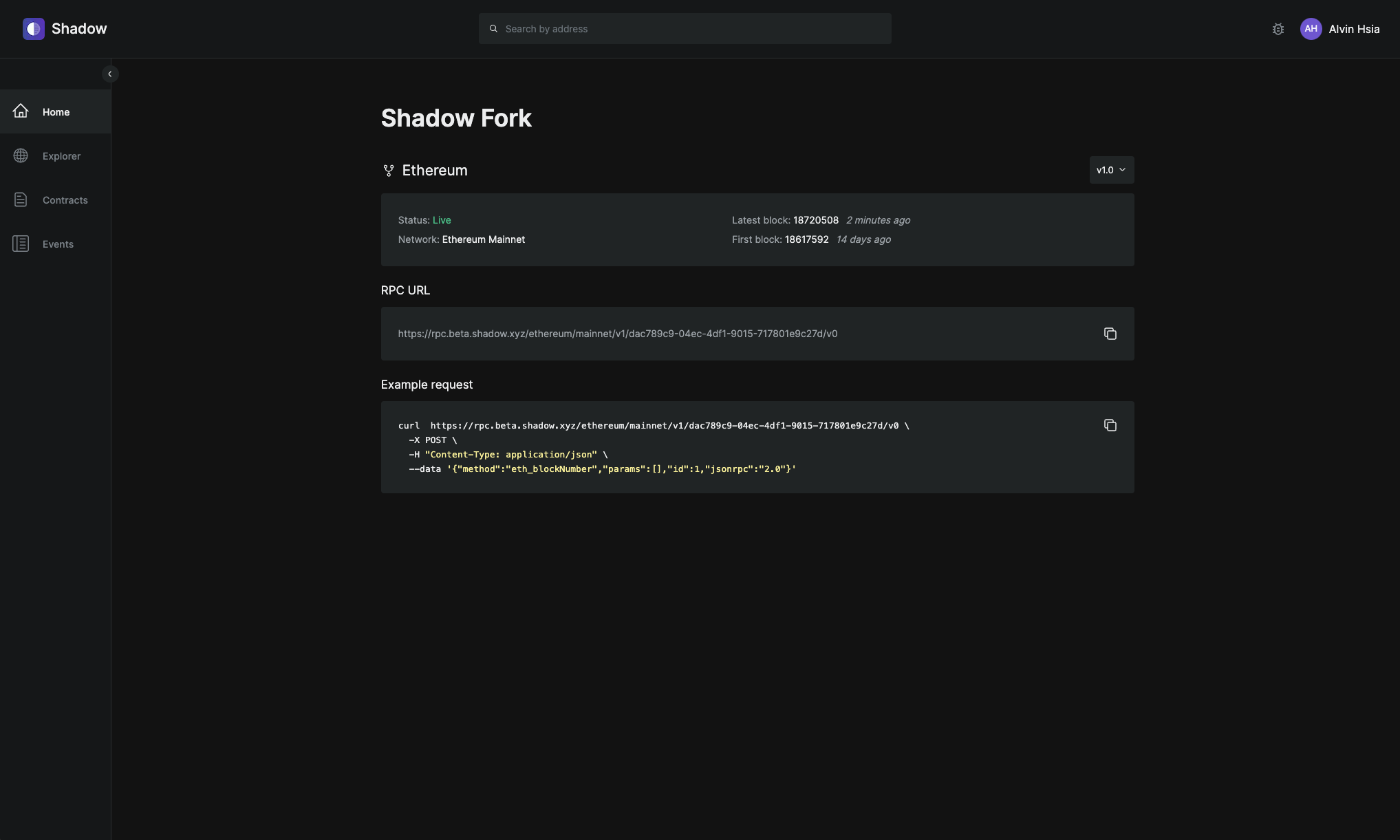
You should see a screen like the one shown below. The string after `project_id=` in the URL is your unique Shadow project ID (e.g. `fc6ee70a-6f14-4a99-81db-6bd96226b95f`).
{% code overflow="wrap" %}
```
https://app.shadow.xyz/?project_id=fc6ee70a-6f14-4a99-81db-6bd96226b95f
```
{% endcode %}
## Step 1 – Add a custom shadow event
Navigate to the WETH token contract page by pasting the contract address into the search bar `0xc02aaa39b223fe8d0a0e5c4f27ead9083c756cc2`
Click the “Open in editor” button on the top right to open the in-browser IDE.
At the top of the contract on L27, define a new event schema called HelloWorld:
```solidity
event HelloWorld(string message);
```
Then, add a line to emit a HelloWorld log at L74 with a custom message every time WETH is transferred:
HelloWorld("Emitting my first shadow event");
After you’re done with your changes, hit the “Compile” button on the top right.
## Step 2 – Test your changes
Test run your changes by simulating a transaction, and confirming that the transaction has logged your new shadow event.
Click the “Test Run” button on the top right, paste in the following transaction hash, and hit “Run”: `0x2ce5687567574b47c9406df5b65c1d9dd0d94bdcdde7109810b642c35599774b`.
You should see your new `HelloWorld` shadow event in the right hand panel!
## Step 3 – Deploy your shadow fork
Now that you’ve tested your shadow changes, you’re ready to deploy the shadow contract onto your shadow fork. Just hit the “Deploy” button on the top right corner.
## Step 4 – Make a JSON-RPC request
Now that you've deployed your shadow changes, you're ready to request the data from your shadow fork's RPC. Here's how you would make an `eth_getLogs` request from your terminal.
```sh
curl https://rpc.shadow.xyz/ethereum/mainnet/v1// \
-X POST \
-H "Content-Type: application/json" \
-H "X-SHADOW-API-KEY: " \
--data '{
"method": "eth_getLogs",
"params": [{
"fromBlock": "safe",
"toBlock": "latest",
"address": "0xc02aaa39b223fe8d0a0e5c4f27ead9083c756cc2",
"topics": []
}],
"id": 1,
"jsonrpc": "2.0"
}'
```
***
That's it! You have successfully generated custom data on your own shadow fork :last\_quarter\_moon: